

Overview and comparative lens
Manufacturers face two related but distinct choices: adopt an industrial automation solution built for specific workflows, or implement industrial automation as a broader practice across operations. This piece compares the approaches through a clear, task-focused lens so teams can match technology to production realities. For battery lines, a focused example of battery manufacturing automation often forces that choice earlier than other product lines because of cell handling, thermal requirements, and traceability demands.

What each term actually means
Think of “industrial automation” as a set of principles and capabilities—sensors, PLCs, networks, control logic, and data practices—that any manufacturer can apply. “Industrial automation solutions” are packaged implementations around those capabilities: vendor systems, turnkey cells, or modular lines tuned for particular products. The difference matters. One is a mindset and toolkit; the other is a delivered product that embeds design choices and constraints.
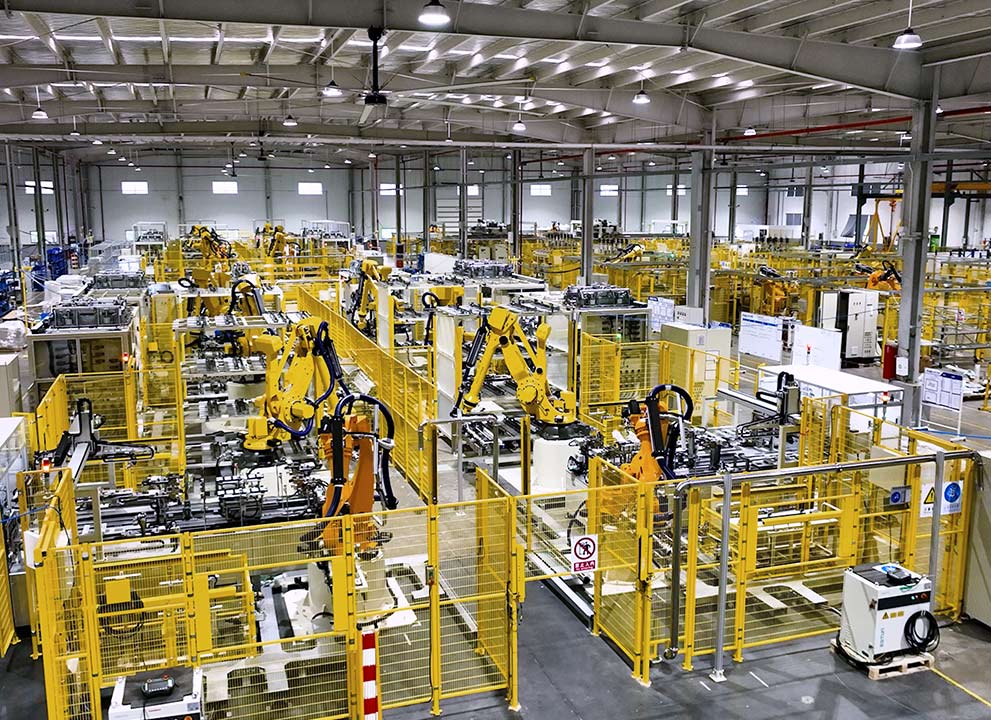
Core components compared
– Scope: industrial automation spans facility-wide control strategies; industrial automation solutions target discrete production challenges. – Customization: solutions tend to be configured or fixed; broader automation is built from interoperable building blocks. – Ownership: solutions can reduce internal engineering effort but can add vendor lock-in; platform automation keeps control in-house but requires more integration work. – Data: both capture process data, but solutions often include prebuilt analytics while platform approaches require bespoke models and dashboards.
Performance and quality control in BESS assembly
Battery energy storage systems impose tight quality gates. Operators need consistent torque, precise adhesive deposition, and cell-level traceability. A BESS assembly line that uses a packaged solution may reach validation faster; a platform approach lets teams iterate inspection logic as cells or chemistries change. Practical observations from panels at the International Battery Seminar show that teams trading agility for speed-to-market often return to modular automation to adapt to new cell formats. If validation cycles matter, choose the path that shortens requalification time.
Deployment models and scalability
Pick by how you plan to grow. Solutions are efficient for repeated product runs and standardized factories. Platform-style automation is better if you expect frequent product changes, multiple SKUs, or phased capacity growth. Consider deployment cadence: roll out a single validated solution cell first, then scale; or build a scalable automation backbone that accepts new tooling without full redesign.
Costs, ROI, and measurable trade-offs
Do the math in three buckets: capital expenditure, integration labor, and change cost. Packaged solutions lower integration labor at higher initial capex and potential upgrade fees. Platform automation lowers vendor dependency but raises internal engineering hours. Measure ROI by cycle time improvement, defect reduction rate, and time-to-requalify when designs change. Use simple run-rate scenarios rather than optimistic full-utilization models.
Common mistakes and how to avoid them
– Treating a solution as a permanent fix: design with exit paths and data access. – Underestimating change cost: validate how much rework a new cell format triggers. – Ignoring maintenance flows: operations lose throughput if maintenance access wasn’t part of the automation design. – Forgetting traceability: battery lines require per-cell histories; ensure the system writes immutable records.
Alternatives and practical recommendations
For many manufacturers, a hybrid approach works best: deploy a targeted industrial automation solution for critical, validated operations (assembly, formation, cell handling) and build a platform for peripheral systems (material flow, visual inspection, plant analytics). When evaluating vendors, prioritize open interfaces and explicit migration paths. When building in-house, document standard modules and automate tests so future changes are contained.
Conclusion
Choose by constraint: if you need speed and repeatability on a single product, a targeted solution reduces ramp time; if you need flexibility across evolving products, a platform approach preserves options. Practical implementation choices—cell handling design, inspection placement, and data architecture—decide whether a line behaves reliably at scale. For manufacturers aiming to balance validation speed with long-term adaptability, consider proven implementations in battery contexts and partners that provide both the packaged workflow and the migration path, such as FHS.