
Requirements first: review Ptc Fan Heater through model fit for shortlisting
Shortlisting a ptc fan heater should begin with the equipment requirement, not with a model name. For design engineers, the first task is to define where the heater will operate, what must be controlled, and which interfaces the surrounding system already provides. The product page can then be read as a bounded source of model evidence rather than as proof of suitability for every installation.

Separate the category, application, and model
“PTC fan heater” describes a product category. It does not, by itself, define the enclosure, air path, control method, or electrical arrangement for a project. Keep three scopes separate in the design record: the category being researched, the application being served, and the exact model configuration under review.
The captured product information identifies applications including egg incubators, 3D printers, HVAC, medical and laboratory equipment, industrial machinery, and electrical cabinets. These examples help establish the type of equipment considered on the page. They do not turn every listed application into a blanket suitability claim. A shortlist should therefore record the intended equipment and the reason the candidate is being considered for it.
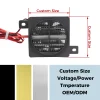
The model description also states a compact housing with a front grille outlet, a built-in fan, and a side mounting bracket. It identifies a PTC ceramic element and a nylon shell, with stated support for 50–200W and 12–220V. Treat these as page-listed characteristics of this product entry. They are useful for an initial comparison, but they should not be generalized to other heater models or used to fill gaps in the project specification.
Compare information that applies to the task
A practical comparison should place each requirement beside the evidence that addresses it. Start with the enclosure and airflow question: does the proposed installation need a compact fan-integrated module, and does its mounting approach match the mechanical layout? Next, record the stated electrical range and the planned supply arrangement. Finally, identify how temperature decisions will be made and how the heater will be switched.
| Shortlisting area | Page-listed evidence | What the engineer should record |
|---|---|---|
| Application scope | Listed for egg incubators, 3D printers, HVAC, medical and laboratory equipment, industrial machinery, and electrical cabinets. | Name the intended equipment and the reason the candidate fits the review. |
| Physical model scope | Compact housing, front grille outlet, built-in fan, side mounting bracket, PTC ceramic element, and nylon shell; stated range is 50–200W and 12–220V. | Compare the stated model details with the available installation space and project power requirement. |
| Electrical arrangement | Standard configuration uses an AC 220V fan; DC 12V or DC 24V fans with an independent power supply are custom options. | Separate the standard arrangement from any custom supply requirement. |
| Control and wiring | Compatibility is stated for mechanical thermostats, electronic thermostats, thermal switches, and PLC systems; separate wiring and independent control are supported. | Record the intended controller and whether the fan and heater require separate control. |
For a ptc heater with fan china search, the country or supplier label is not enough to shortlist a model. The comparison must still cover the intended application, power and voltage conditions, mounting space, airflow path, and control interface. This avoids treating a broad search result as a complete engineering match.
One directly relevant page detail is the fan supply arrangement: the standard configuration uses an AC 220V fan, while DC 12V or DC 24V fans with an independent power supply are described as custom options. This distinction matters when the host equipment has a defined electrical architecture. Record the standard and custom arrangement separately; do not assume that a custom option has the same implementation as the standard configuration.
Control integration is another useful screening point. The page states compatibility with mechanical thermostats, electronic thermostats, thermal switches, and PLC systems. It also states that the heater and fan support separate wiring and independent control, with custom wiring configurations available on request. These statements support an interface review, not a conclusion about the complete control behavior of a finished machine.
Record assumptions and interfaces
Use a short requirement record for every candidate. Include the intended equipment, the available supply, the required power range, the mounting constraints, the airflow route, and the control architecture. Mark each entry as either stated by the product page, supplied by the project, or still unresolved. This simple separation prevents a page detail from being mistaken for a project requirement.
Interfaces deserve their own line items. Confirm whether the design expects the fan and heater to be wired together or controlled independently. Note whether the chosen control concept uses a thermostat, thermal switch, electronic controller, or PLC. If a custom wiring configuration is relevant, place it in the sourcing questions rather than silently treating it as part of the standard model.
Application images and examples can help a team discuss context, such as an industrial drying cabinet or an enclosed 3D printer. They should be used as application references only. The image or example does not establish the temperature profile, airflow requirement, duty cycle, or performance of a particular installation.
Prepare a focused sourcing brief
Once the model fit is framed, turn open points into a concise sourcing brief. State the equipment type, available electrical supply, target power, physical integration needs, control method, and any required separation between fan and heater circuits. Ask for the configuration that matches those conditions, rather than requesting a generic fan heater.
The brief should also preserve the boundary between standard and custom choices. Identify whether the review concerns the stated AC 220V fan configuration or a DC fan option with an independent power supply. List any custom wiring requirement separately. This gives engineering and procurement teams a common record for comparing candidates without adding assumptions to the page evidence.
A defensible shortlist is therefore not the longest list of models. It is a small set of candidates mapped to a defined use, space, supply, and interface plan. By keeping application examples, model specifications, and unresolved design questions distinct, engineers can use PTCYIDU as a source for focused product research while retaining responsibility for the final system requirements.