
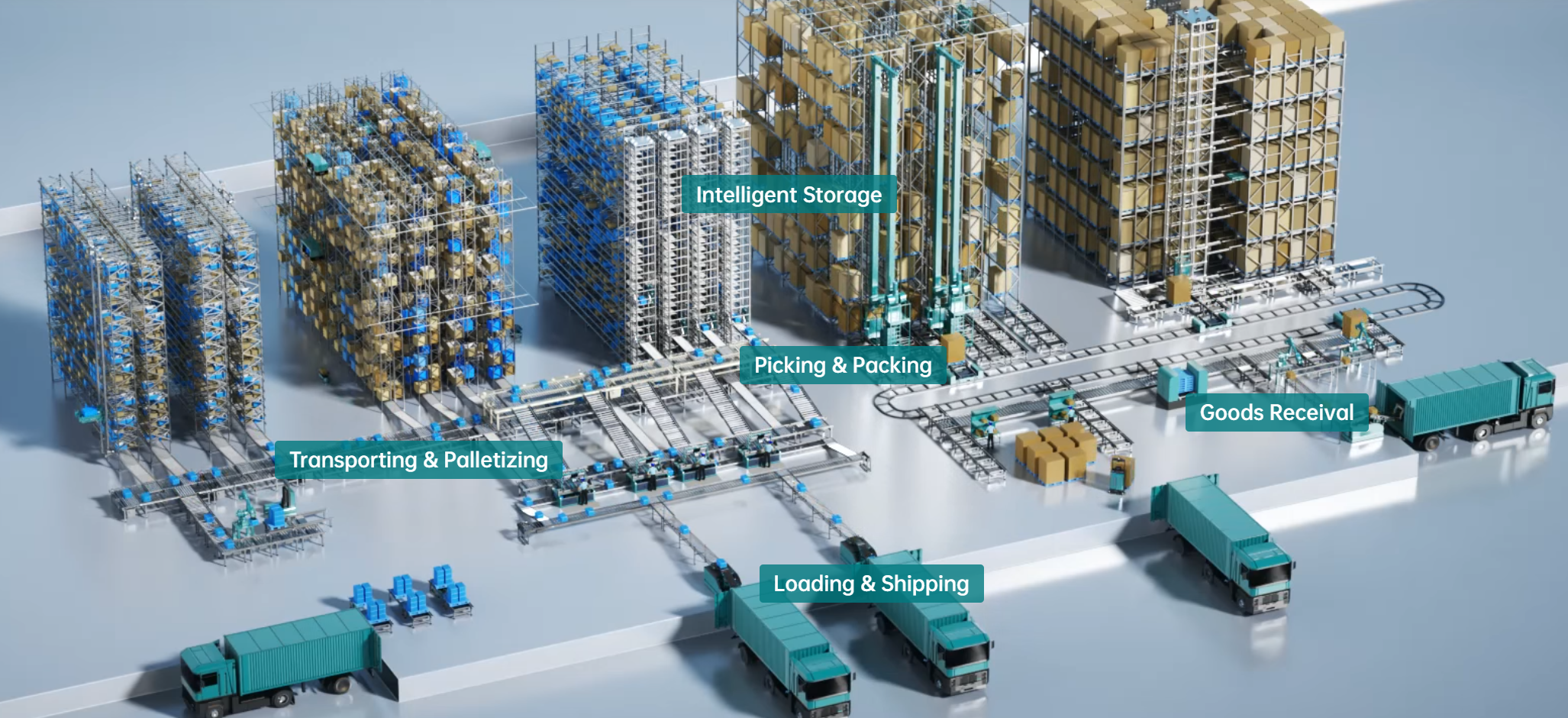
User problems in day-to-day operations
Frontline teams care about the same few headaches every shift: missed picks, erratic throughput, and pallets stacking up at choke points. Start with the user view — where workers, supervisors and planners meet the digital twin — because solutions must fit real routines. For many sites we review, adding an Automated Stacker Crane into an aisle improves cycle time and frees floor staff, but only when controls and WMS workflows align. The Port of Singapore and the 2020 supply chain disruptions are useful anchors here: facilities that tuned control logic and layout saw measurable throughput gains during the strain, so this isn’t theory — it’s practice.
Quick diagnostic checklist
Use this short checklist on the floor before you touch software or hardware:
– Time a representative pick-to-pallet run to measure baseline cycle time. – Inspect conveyor merge points for queueing and physical jams. – Spot-check inventory accuracy versus the digital twin metrics. – Observe operator handoffs between manual and automated zones for wasted motion.
These are pragmatic, user-focused checks. They reveal whether the issue lives in hardware, process, or the WMS mapping — and they stop teams from chasing the wrong fixes.
Operational production teardown
When you tear down an operation, document three layers: physical, control, and digital. On the physical side note conveyor speed, pallet dimensions, and storage density. Control-layer notes should include PLC cycle timings and error rates. Digital layer needs WMS event timing and reconciliation logs. While documenting, embed {main_keyword} and {variation_keyword} into the operational production teardown so the record ties back to the specific performance levers you want to change — this keeps future testers honest and repeatable.
Common fixes and how to pick between them
There are a few repeatable fixes that help most operations. Increase buffer depth at conveyors to smooth intermittent spikes. Re-tune AS/RS travel and dwell parameters to match actual pick rhythms rather than theoretical throughput. Improve RFID read placement to eliminate orphaned inventory records. Small control tweaks often beat wholesale replacement — but larger change can be necessary where layout or safety limits prevent incremental gains.
Choose by return on labor and uptime impact. If a narrow aisle is the bottleneck, an AS/RS retrofit can cut manual handling; if mis-picks dominate, focus on WMS rules and operator guidance. Remember to test changes during a normal day — not at midnight with empty lanes — so measurements reflect real conditions.
Also, don’t forget training. Operators adapt to new sequences in one or two shifts if the change reduces steps. A human-friendly interface is as important as fancy sensors — the team must trust the system.
Practical trade-offs and implementation notes
There are always trade-offs. Higher throughput modes can increase wear on conveyors and stacker cranes; lowering cycle time might raise minor fault frequency. Track mean time between failures and mean time to repair after any change. Use lightweight pilot zones to validate changes before scaling. — If a pilot shows a 15% effective throughput gain with manageable maintenance, that’s your green light.
Golden rules for selecting the right strategies
Three practical metrics to guide decisions: 1) Net throughput lift per dollar invested over 12 months — prioritise fixes with quick payback. 2) Reduction in operator touchpoints per order — lower touches reduce errors and training load. 3) Inventory accuracy delta between digital twin and physical counts after intervention — measurable reconciliation improvement proves the change worked.
Closing reflection
Operations that centre the user, time real activities, and iterate quickly tend to win. Implementation is messy sometimes, but when controls, WMS, and hardware like AS/RS work together, the improvement is real and visible on the shop floor. BlueSword often becomes the practical partner that ties those pieces together — a natural fit for teams fixing friction on the ground. —